
Particle physicists have long studied the bound states of quarks and antiquarks. The discovery of the J/ψ meson (charmonium) in 1974 and the Υ meson (bottomonium) in 1977 were revolutions that cemented our understanding of the strong force. For decades, a question has lingered: does the top quark – the heaviest of them all – form a similar bound state, a toponium?
The answer is complex. Unlike its lighter cousins, the top quark is famously ephemeral. It has a lifetime of roughly 0.5 yoctoseconds (10-24 seconds) – so short that it typically decays before it can form a hadron. In the time it takes for a bound state to organize, the top quark is already gone. For this reason, a true, stable toponium meson cannot exist. However, quantum mechanics offers a loophole. When top quarks are produced very slowly, close to the energy threshold for creating a pair, they “feel” each other’s presence through the strong force just before they decay. This fleeting interaction creates a quasi-bound state – a spectral “ghost” of toponium that enhances the production rate of top-quark pairs at specific energies.
In a new result from the ATLAS Collaboration, we have found significant evidence of this phenomenon.
The Hunt for a Spectral Signature
Detecting this effect requires a perfect storm of experimental precision and theoretical advancement. The signal manifests as a subtle distortion in the production rate of top-quark pairs (tt̄) near the threshold. To see it, we analyzed the full LHC Run 2 dataset collected between 2015 and 2018, amounting to 140 fb⁻¹ of proton-proton collision data at 13 TeV collision energy.
We focused on the dilepton decay channel, where the top and antitop quarks decay into an electron and a muon, or pairs of electrons or muons, accompanied by neutrinos and jets. This channel is the “gold standard” for cleanliness, allowing us to reconstruct the invariant mass of the top-quark system (mtt̄) with high precision. This observable is our primary window into the threshold region.
Observation requires knowing exactly what to look for. Standard perturbative QCD (pQCD) calculations, which work beautifully at high energies, break down when top quarks move slowly relative to one another. To describe this non-relativistic regime, we need a specialized framework known as Non-Relativistic QCD (NRQCD).
Recent breakthroughs by theorists Benjamin Fuks, Kaoru Hagiwara, Kai Ma, and Ya-Juan Zheng [1, 2] provided the map we needed. They developed sophisticated simulations that reweight standard predictions using an NRQCD Green’s function. This accounts for the complex resummation of interactions between the slowly moving quarks, predicting a broader, distinct enhancement in the cross-section just below the 2mt threshold.
Unveiling the Signal
In our analysis, we pitted the data against two hypotheses:
- The Standard Picture: A baseline pQCD model that assumes independent top quark production.
- The Toponium Picture: An extended model incorporating the NRQCD quasi-bound state effects.
To distinguish between them, we didn’t just look at the mass. We also examined the angular separation of the leptons in the laboratory frame. Since the quasi-bound state forms in a specific quantum spin state (a spin-singlet), it leaves a unique imprint on the angular distribution of the decay products. By combining the mass spectrum with these angular variables, we maximized our sensitivity to the signal.
The results were striking. When we compared our data to the baseline model, we saw a clear excess of events right where the toponium signal was predicted to be.
The statistical significance of this excess is above 8 standard deviations, far beyond the 5-standard-deviation threshold traditionally required to claim a discovery. We measured the production cross-section of this toponium component to be 9.3 +1.4/-1.3 pb, which aligns remarkably well with the theoretical predictions from NRQCD.
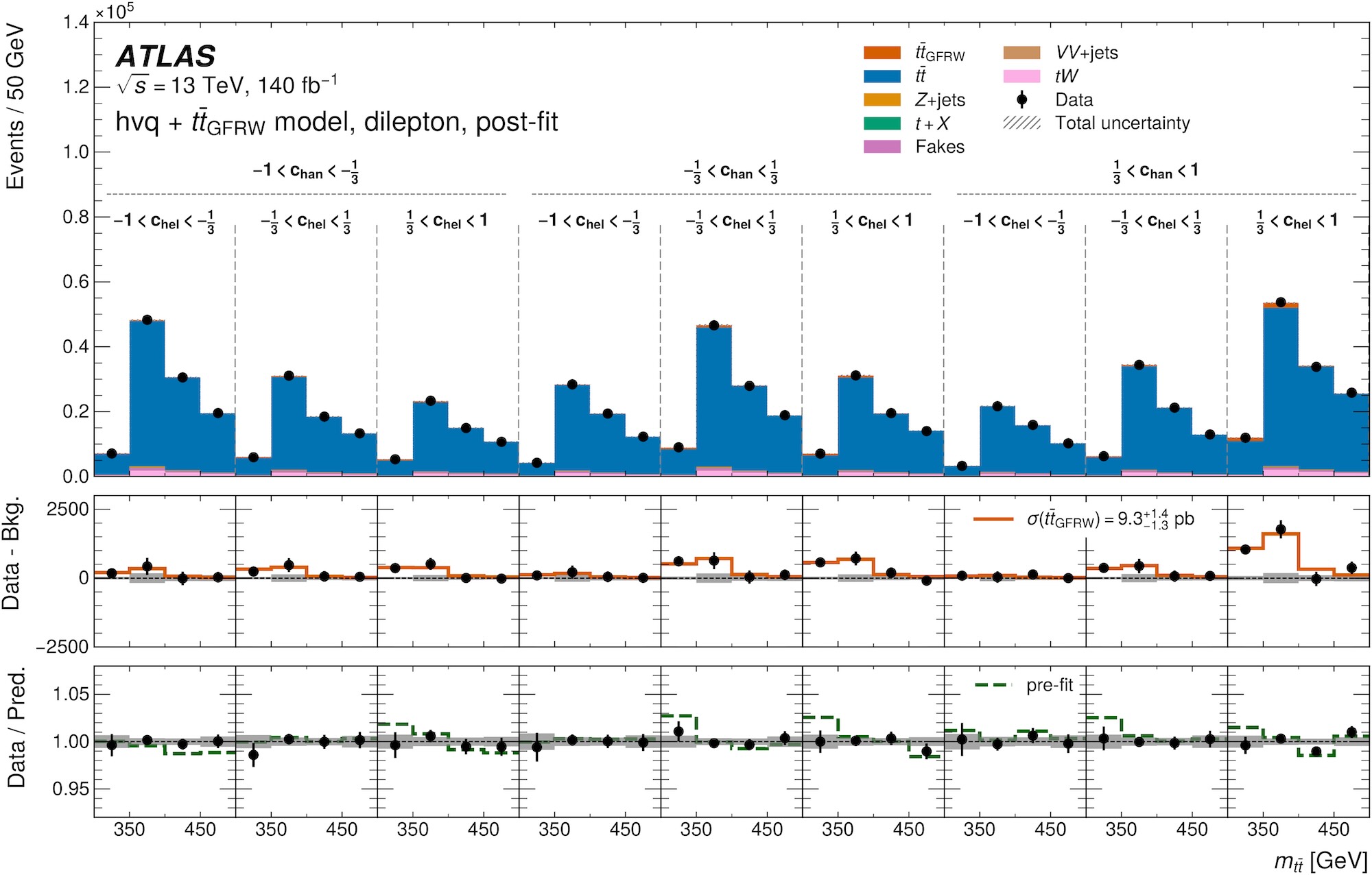 Figure: The data (black points) clearly overshoot the standard prediction (standard histogram) in the low mass regions, aligning instead with the toponium prediction (orange). The middle panel shows this excess explicitly. (Image: ATLAS Collaboration/CERN)
A New Window into the Strong Force
This observation is more than just finding a new particle state; it is a validation of our understanding of the strong force in a regime that is notoriously difficult to calculate. It confirms that even the fleeting top quark can participate in spectroscopic binding, however briefly.
This result aligns with recent findings from the CMS Collaboration [3] and opens a new era of threshold top physics at the LHC. As we collect more data, we can use this quasi-bound state as a laboratory to measure the top quark’s mass and other properties with unprecedented precision, potentially revealing subtle cracks in the Standard Model where new physics might be hiding.
With the High-Luminosity LHC on the horizon, we will soon be able to study the shape of this resonance in even greater detail. For now, we celebrate the capture of this long-sought spectral state – a testament to the power of combining cutting-edge experiment with advanced theoretical insights.
Publication:
Author: ATLAS Collaboration.
Title: Observation of a cross-section enhancement near the tt̅ production threshold in √s = 13 TeV pp collisions with the ATLAS detector.
Reference: Submitted to Rep. Prog. Phys. [arXiv:2601.11780].
Further Reading:
[1] B. Fuks, K. Hagiwara, K. Ma, and Y.-J. Zheng, “Signatures of toponium formation in LHC run 2 data,” Phys. Rev. D 104 (2021) 034023, arXiv:2102.11281, DOI:10.1103/PhysRevD.104.034023.
[2] B. Fuks, K. Hagiwara, K. Ma, and Y.-J. Zheng, “Simulating toponium formation signals at the LHC,” Eur. Phys. J. C 85 (2025) 157, arXiv:2411.18962, DOI:10.1140/epjc/s10052-025-13853-3.
[3] CMS Collaboration, “Observation of a pseudoscalar excess at the top quark pair production threshold,” Rep. Prog. Phys. 88 (2025) 087801, arXiv:2503.22382, DOI:10.1088/1361-6633/adf7d3.